
Share :


Running a successful jewelry boutique or retail online store involves a delicate balancing act. You need captivating designs, impeccable quality, and an enticing brand presentation. However, one of the most critical factors that can make or break your sales numbers is often overlooked: your ring size inventory breakdown.
There is nothing quite as frustrating for a customer—or a store owner—as finding the perfect sterling silver band, only to discover that it is not available in their size. When a specific size is out of stock, it doesn’t just mean a delayed sale; it frequently results in a lost customer who walks away to find an immediate alternative. On the flip side, blindly overstocking extreme outlier sizes ties up precious working capital that could be better spent on moving inventory.
To help you optimize your display cases and digital storefronts, this comprehensive guide explores the data behind the fastest-moving ring sizes, regional variations, measurement strategies, and essential purchasing tips. By aligning your stock with proven consumer trends, you can satisfy demand, boost turnover rates, and cultivate long-term customer loyalty.
When analyzing retail data across North America, Europe, and Australia, consumer demand naturally clusters around a predictable bell curve. Understanding these central benchmarks allows you to allocate your inventory budget where it yields the maximum return.
For standard women’s rings, the average US ring size requested by retail consumers is Size 7. The core sweet spot that covers the overwhelming majority of your customer base spans from Size 6, 7, and 8.
Sizes 5 and 9: These represent important perimeter sizes. While they move slower than the core sizes, they are absolutely necessary to satisfy petite fingers as well as thumb or index finger wearers.
Sizes below 5 and above 9: These are specialized outlier sizes. They should be stocked conservatively unless your boutique caters to a highly specific demographic.
If your retail business features masculine collections or gender-neutral bands, the sizing dynamic shifts higher. The average men’s US ring size is Size 10. Your high-volume inventory core for men should focus tightly on Sizes 9, 10, and 11.
Pro Tip for Retailers: If you are launching a brand-new collection and want to manage your initial cash flow safely, try implementing an inventory purchasing ratio of 1:2:3:2:1. For example, when buying 9 pieces of a woman’s ring style, purchase 1 piece of Size 5, 2 of Size 6, 3 of Size 7, 2 of Size 8, and 1 of Size 9.
While it is tempting to only purchase Sizes 6, 7, and 8 to save on costs, a strictly limited size selection can hurt your brand’s reputation. Modern jewelry buyers expect inclusivity and versatility. If a shopper visits your store and realizes you only cater to a rigid average, they may feel excluded and choose not to return.
The solution is to find an agile sourcing partner. Working alongside an experienced silver jewelry wholesale Thailand manufacturer allows you to maintain a diverse size range without overextending your budget. By choosing a wholesale 925 sterling silver rings supplier with low minimum order quantity (MOQ) model, you can order a wide range of sizes in smaller batches. This keeps your inventory fresh, accommodates more customers, and prevents your capital from getting locked up in excess stock.
In our interconnected global marketplace, your customers might be shopping locally, but your supply chains or international buyers could operate on entirely different systems. Ring sizes are determined differently across major global fashion hubs:
United Kingdom, Ireland, and Australia: Uses an alphabetical scale (e.g., Size L or Size O), with half-sizes denoted as “L ½”.
Continental Europe (France, Germany, Italy): Uses a numerical system that corresponds directly to the internal circumference in millimeters (e.g., a 54mm circumference is a size 54).
Japan and China: Utilizes a unique numerical scale that differs completely from the US system (for instance, a US Size 6 corresponds roughly to a Japanese Size 11).
To avoid costly ordering mistakes, it is vital to keep a trusted conversion reference handy when coordinating with international suppliers. (See our comprehensive conversion chart at the end of this guide).
Inventory planning is no longer just about matching standard sizes; it is also about keeping up with changing consumer habits. The way people wear rings today affects the sizes they buy.
The global trend of multi-finger styling has completely changed retail demand. Consumers are no longer buying a single ring for the traditional ring finger. They are accessorizing pinkies, index fingers, thumbs, and mid-knuckles simultaneously. This style shift has significantly driven up demand for smaller sizes (for pinkies and midi-rings) and larger sizes (for thumbs and index fingers). To dive deeper into capitalizing on this profitable phenomenon, explore our strategic guide on the rise of stackable silver rings: a wholesale opportunity.
A common pitfall for retailers is ordering wide statement bands or chunky signet rings in the exact same size ratios as thin, delicate bands. As a rule of thumb, the wider the ring band, the tighter it fits. Thicker styles (typically 5mm or wider) trap more skin underneath and do not slide over the knuckle easily.
When stocking wide-profile styles, always advise your customers to size up by a half or full size for a comfortable fit. From an inventory management perspective, shift your buying curve slightly higher for thick bands—stocking fewer small sizes and adding more on the larger end of the spectrum. For a full breakdown of design variations and construction techniques, consult the types of silver rings: a retailer’s guide.
Helping customers find their perfect fit minimizes return rates and maximizes satisfaction. Ensure your retail team is trained on these essential measuring practices:
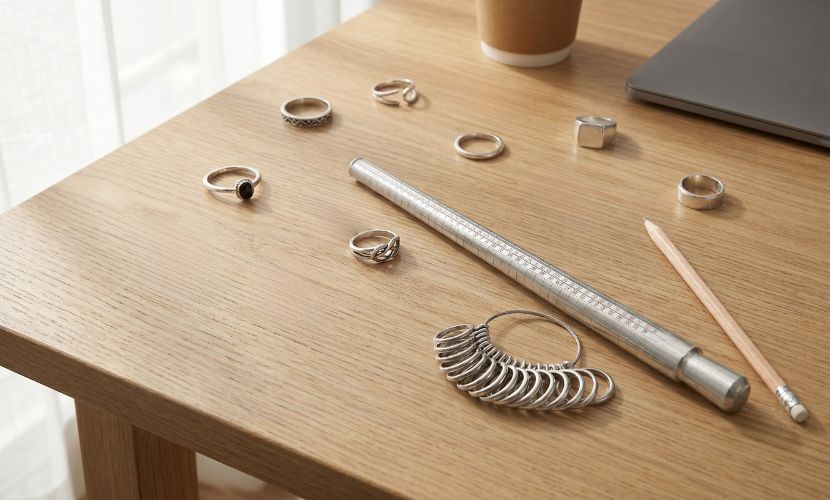
Use Professional Calibration Tools: Always rely on standardized metal sizing rings or a precise ring mandrel rather than paper strip printouts.
Account for Environmental Factors: Fingers swell in warm weather, after workouts, or in the evening. Conversely, fingers shrink in cold environments. Aim to measure fingers at room temperature at the end of the day for the most accurate fit.
Knuckle Awareness: If a customer has prominent joints, take two measurements—one at the base of the finger and one around the widest part of the knuckle—and choose a size right in the middle so the ring slides on comfortably but securely.
Optimizing your ring sizes is a powerful way to boost your store’s sales and efficiency. To put these strategies into action, you need a dependable manufacturing partner who values precision, quality, and flexible ordering options.
Planet Silver, a trusted brand name behind the scenes, provides world-class manufacturing directly from Thailand’s premier jewelry production hubs. By visiting the Planet Silver wholesale jewelry shop, you unlock access to an expansive collection of premium 925 sterling silver designs across all standard and extended sizing ranges. Because they support small and growing businesses with low minimum order quantities, you can confidently build a well-balanced, inclusive inventory that meets your customers’ needs without overextending your budget.
Use this reference table to convert measurements accurately when placing wholesale orders or assisting international clientele: https://staging.planet925.com/ring-sizes/